
The Moon represents your emotional habits, instincts, and inner world. This article helps you understand how your Moon sign shapes your actions, reactions, and needs. You will blend Moon symbolism with sign symbolism and complete an astro activity to gain insight into your habits and emotional patterns that can lead to change. Before you read the article, pick a level focus to make it most useful. There are three levels to choose from depending on your knowledge and practice of astrology.
| Level | What You’ll Learn | What You Need to Know First | How to Use This Article |
|---|---|---|---|
| Beginner |
• Moon basics • How to blend Moon + sign • How to reflect on emotions & habits |
• Your Moon sign (from your natal chart) |
• Focus on simple key ideas • Mirror the examples • Use reflection questions |
| Intermediate |
• How your Moon theme changes over time • How symbolic parts of the Moon grow with age |
• How you’ve interpreted your Moon before • Which Moon themes do you see changing |
• Observe your Moon themes at different ages • Make meaning of the changes of your Moon over time |
| Advanced |
• Moon as a living emotional cycle • Tides, phases, rhythms • How cycles reveal timing & meaning |
• Awareness of your emotional cycles • Comfort with symbolic interpretation |
• Add your own Moon knowledge • Interpret your Moon as a cycle • Use lunar metaphors to deepen insight |
The meaning of the Moon and its practical, personal, and historical power distilled into astrological symbolism has been written and revised over history and culture. The moon shows its light in a constant cycle. Its shape is always waxing and waning. From nothing it grows full, then disappears, only to begin anew. The moon is a reminder of renewal and loss, youth and age, planting and harvesting. The moon can pull the tides of the oceans. It can make it easier to see in the dark, or not. It can inspire rituals and traditions. Can it transform humans into werewolves? Inspire lunacy? Bestow magical power on special nights?
The moon is personal. Humans connect to it and celebrate it in groups but also on their own. Do you sing to the moon? Speak to the moon? Stare at the moon? Think of those who are distant from you looking at the same moon? The moon’s impact on humans is undeniable. Across cultures, the moon has guided humans in practical day-to-day life like planting and harvesting, calendar creation, and inspiring myths to make meaning of the world. The moon's power is evident during its rituals and celebrations, and in moments of quiet reflection.
In Egypt, the moon was associated with Thoth, god of wisdom and writing. Certain moon phases were believed to influence fertility, time, and magic. In Mesopotamia, the moon was Sin (Nanna), a deity ruling night. His cycles were tied to fertility and agriculture. In Greek and Roman traditions, the moon was linked to Artemis and Diana, goddesses of hunting, wilderness, fertility and childbirth as well as protecting women. In Scandinavia, the moon was personified as Máni, representing the eternal cycle of time being chased across the sky. Many key words stand out defining the themes of the moon including time, cycles, women, childbirth, nature, agriculture, magic, night, and the wilderness.
These stories, keywords, and themes are the perfect introduction to the meaning of the moon as it turns into the Moon in astrology.
In Western astrology, the Moon is a personal, private and profound symbol in the chart. The Moon is deeply personal because it symbolizes your habits, your quiet self, how you were mothered and how you mother (men and women both receive and express mothering behaviors). The Moon symbolizes the inborn nature exhibited when you are not being watched and the habitual patterns of your daily life. If you believe in multiple lives, it represents your past life experiences turned into attributes.
The Moon is private because it connects to your home, where you come from, where you go to feel safe. The Moon represents cycles- our emotional cycles, our habitual cycles, and the way we change and process changes. The Moon also represents what is found in the dark, what cannot be seen but can still be felt.
The Moon carries the themes of magic and night. It rules the subconscious, dreams, and imagination. In astrology, the Moon is the realm of memory, intuition, and the hidden forces that shape behavior. It is the part of us that responds to ritual, to mystery, and to the power of the night. The Moon symbolizes the wild and untamed, the part of us that is instinctual, emotional, and rebellious. It is the raw, unfiltered self. The power of the Moon encompasses night, the hidden powers and forces inside us, and mysterious cycles that wax and wane.
The many faces of the Moon cannot be captured in a single description. Its themes shift across cultures and stories, yet its essence remains the same. A symbol holds countless truths, waiting to be discovered in each person’s reflection. So how do you begin to uncover your unique Moon?
You get started by learning astrological symbolism and blending skills. Once you have your natal chart information, you study your Moon by looking at the house placement, your Moon’s sign, and any aspects connecting to your Moon. For now, in this article, the first step will be looking at your natal chart Moon sign and blending the energy of the sign with the energy of the Moon.
When blending the Moon with a sign, remember this is only step one. Other chart factors — house placement, aspects, rulership — add layers that make the description more personal and precise. Understanding Moon sign symbolism is a good place to start to learn astrological techniques and to learn about a natal chart. To begin, use shorthand definitions and key information to think about both the Moon and the signs. Avoid long lists or overwhelming histories, which can block intuition. Start small. We will now start with information about the Moon.
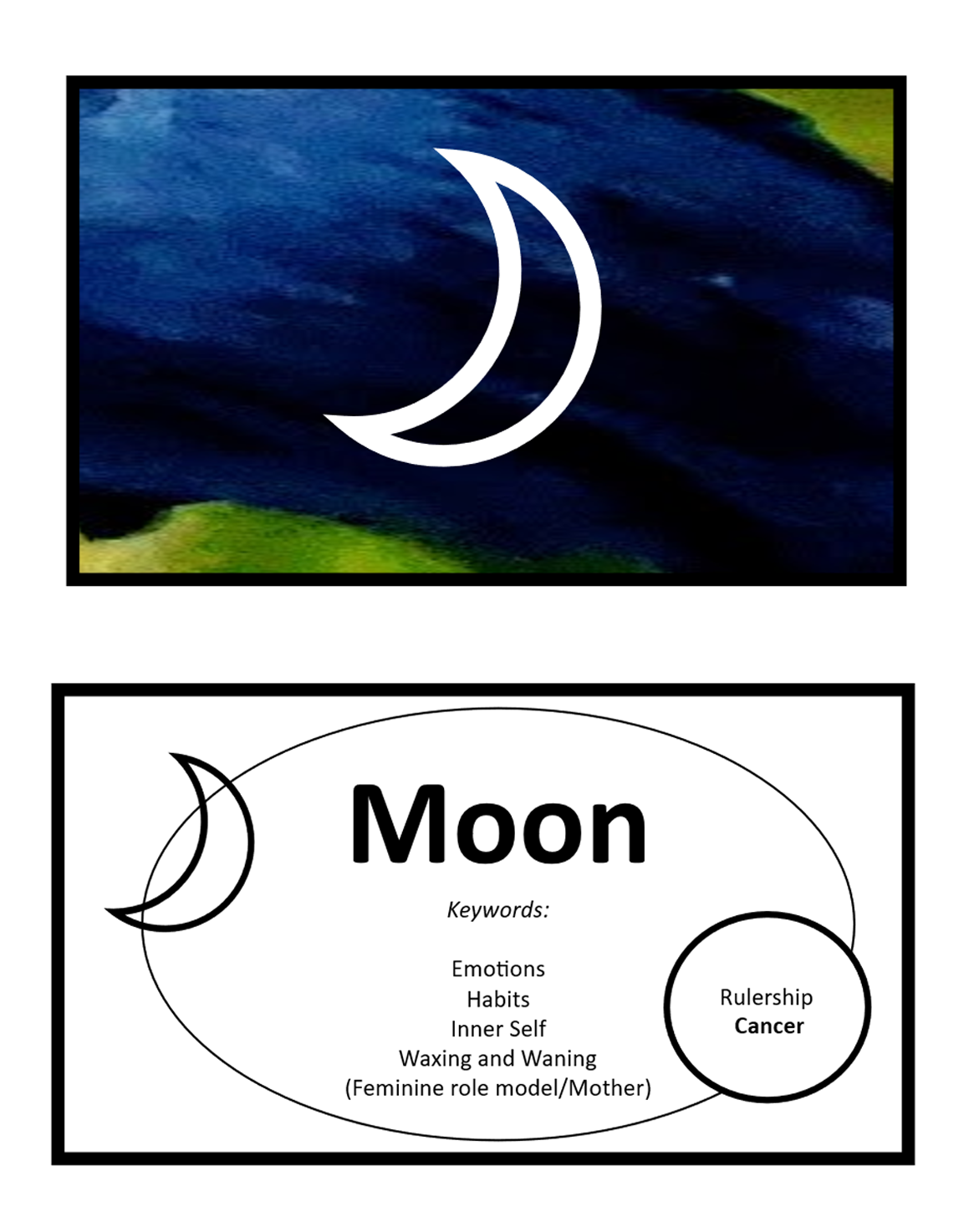
1. Blend the Moon’s symbolism with your sign keywords.
2. Explore Shine and Shadow expressions of your Moon sign focused on habits and emotions.
3. Describe one habit relating to emotions in your life.
4. Write one insight and one action step based on what you discover.
For intermediate and Advanced students add these steps to your instructions before you begin. Beginners — skip ahead.
5. Intermediate — Think about the Moon’s symbolism and mythology as it has changed over time in your life. Use how the Moon’s manifestation has changed as you get older to make a new connection to your Moon. How do your Moon’s traits and character change and remain the same as you connect to your habits and emotions as you grow?
6. Advanced — How can you create a deeper, more nuanced understanding of your habits and emotions through reflecting upon your personal emotional and habitual rhythms as related to your Moon Sign? How do these rhythms and cycles express your Moon traits? What are the themes of the emotional and habitual cycles of your Moon and how can you use them to evolve?
To explore your own Moon sign, blend the Moon with its sign and notice how energies show up in daily life. This is not about memorizing traits but observing patterns. Using the information found on the Insight and Action Astrology Learning Cards, start to create your own keywords, phrases, feelings, or symbols describing Moon characteristics together with the qualities of your sign. (There are short sign sentences at the end of the article you can use if you do not have the cards or are not familiar with your Moon sign characteristics.)
Take your ideas and use them to create a more solid description of your Moon
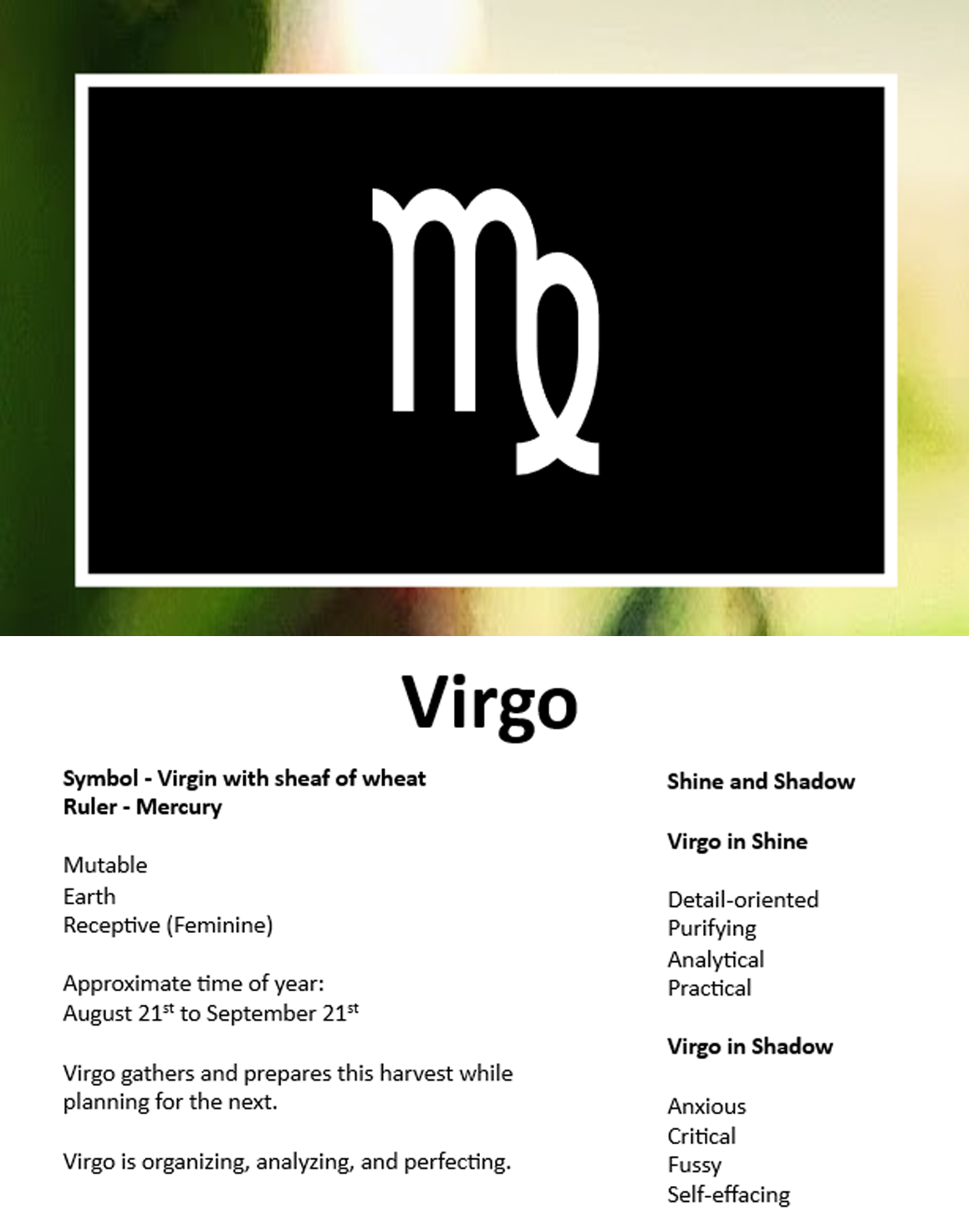
• Moon= Emotions + Virgo=analytical
• Analyzing emotions- thinking about feelings rather than feeling feelings, trying to make sense of feelings or putting them in order
• Moon=Habits + Virgo=detail oriented
Think about yourself and how you exhibit traits of your Moon sign. Use your life experience and knowledge of yourself and add in your new knowledge of your Moon sign tendencies to answer these guiding questions.
1. What do you often do? What are some of your habits? How do you often feel? What emotions usually come up for you?
2. Focus on one activity or habit you often do? When and why do you find yourself doing it?
3. What emotions do you often feel before, during, and after this activity or habit, and how do your feelings shift in relation to it?
Write or draw freely about what you notice about your emotions and habits. Patterns may be clear or complex; both offer insight. We are all complex and we live in our shadows, and in our shine, and usually in both at the same time.
Look at the shadow and shine of your patterns. This duality is not about judgment but awareness. Every Moon sign can be expressed in supportive or harmful ways. Recognizing both sides allows for deeper insight and intentional action. Organize your thoughts about your habits and emotions and write about it.
Check out the example below.
(This example’s traits and themes come from combining the Moon Card keywords with the Virgo card keywords below.)
As a Virgo Moon I desire organization and structure, and it can be hard for me to relax and slow down. So, I often rewatch sitcoms or documentaries with familiar formats to help me unwind while I review the day, or plan upcoming activities while being entertained with something I do not need to analyze. This habit can help me regulate my energy and time, but sometimes I feel stuck in routine and feel that I am always working in some capacity. Sometimes I can get critical and feel like I have no time for myself even though I decided to rewatch the shows. This became a habit to save energy to use to help others or pursue something for myself at another time. Instead, I end up not having time to do what I want or having energy to help others because I am stuck in this habit that is not serving its purpose.
At the Intermediate level, the work begins with noticing your current habits and emotions. Observe what you repeatedly do, how you react, and what you feel in daily life. Once you have a sense of these patterns, you blend them with your Moon sign’s qualities to see how the sign shapes your emotional style and how you instinctively respond. From there, you look at these same habits across time. Think about how they appeared in childhood, adolescence, early adulthood, and now. You’re not interpreting your whole Moon at once; you’re tracing one emotional pattern through different stages of life to see what has stayed the same and what has shifted.
As you compare these moments across your life, personal Moon themes begin to emerge. Once you identify them, you can see how they express your Moon sign and how they have evolved with age. Some habits soften, some strengthen, and some transform into wisdom. This step-by-step process helps you understand your Moon as a living emotional process. It reveals how your Moon sign has shaped your inner world and how your emotional patterns continue to guide your growth. Use the Moon and sign work you have already completed in the article activity and answer the questions below for yourself.
Intermediate- Think about the Moon’s symbolism and mythology as it has changed over time in your life. Use how the Moon’s manifestation has changed as you get older to make a new connection to your Moon. How do your Moon’s traits and character change and remain the same as you connect to your habits and emotions as you grow?
At the Advanced level, you bring together both the main article activity and what you learned in the Intermediate stage, your awareness of your Moon themes and their changes as you age. The emotional habits you formed in childhood, the reactions you relied on as a teenager and new habits that formed in early adulthood all reveal how your Moon has been changing over time. Now add another layer and begin to see these changes not as linear shifts, but as part of a purposeful emotional and habitual cycle. Just like the Moon moves through repeating phases of openness, contraction, intensity, rest, and renewal, so do you. When you blend your Moon sign’s symbolism with these lived emotional cycles, you start to recognize the deeper themes within themes that return again and again — the patterns that shape your habits and emotional life lessons.
As you track these rhythms, you begin to see that your Moon is not simply aging, it is teaching. Each cycle brings a lesson, a reminder, or a refinement of your Moon sign’s core traits. By identifying the emotional phases, you return to most often — and noticing how their expression shifts as you grow — you gain a clearer understanding of your Moon’s evolutionary path. This approach transforms your Moon into a dynamic emotional guide, showing you how your habits, needs, and instincts evolve through repetition, reflection, and the natural rhythms of your life. Use the Moon and sign work you have already completed in the article activity and answer the questions below for yourself.
How can you create a deeper, more nuanced understanding of your habits and emotions through reflecting upon your personal emotional and habitual rhythms as related to your Moon Sign? How do these rhythms and cycles express your Moon traits? What are the themes of the emotional and habitual cycles of your Moon and how can you use them to evolve?
Astrology is a lifelong study, but each step offers immediate insight. When you begin with one chart placement, such as your Moon sign, and then add another layer, and then another, gradually expanding to the whole chart, the learning process becomes more grounded and less overwhelming. This step by step approach allows each insight to settle in, connect to what you already understand, and build a foundation that grows stronger with every new piece you add. This article began with the Moon’s symbolism and ended with personal insight. Astrology invites continual study and reflection. Start small, integrate insights, and expand gradually. Each placement adds depth to your chart, and each step builds confidence. By exploring your Moon sign now, you open the door to learning the rest of your chart in time.
Continue exploring your natal chart and upcoming articles that highlight planetary meanings and methods to help you learn about yourself and the universe.
Astrology grows through both self study and shared wisdom. Articles, cards, and booklets guide study and reflection, and community, mentorship, and classes deepen practice. Your path can be personal and collective, shaped by your own insights and the insights of others. The Insight and Action Astrology Natal Astrology Learning Cards and Foundation Booklet provide a step by step framework and much of the information shared in this article series comes from the design of that resource. Some activities and information in the article series will overlap with the cards and booklet work, and some will be unique to the article. Use the articles and Insight and Action Astrology Natal Astrology Learning Cards and Foundation Booklet together for extra enrichment, activities, examples, and support.
(This list is a short sentence description that comes from a part of the Insight and Action Astrology Learning Cards.)
• Aries: Aries is self assertive, driven, and self directed.
• Taurus: Taurus is steady, grounded, and attached.
• Gemini: Gemini is interactive, inquisitive, and on the move.
• Cancer: Cancer is receptive, emotional, and nurturing.
• Leo: Leo is confident, energetic, and full of heart.
• Virgo: Virgo is organizing, analyzing, and perfecting.
• Libra: Libras are harmonizing, diplomatic, and thoughtful.
• Scorpio: Scorpio is reserved, deep, and passionate.
• Sagittarius: Sagittarius is seeking, optimistic, and opinionated.
• Capricorn: Capricorn is focused, goal oriented, and structured.
• Aquarius: Aquarius is futuristic, detached, and independent.
• Pisces: Pisces is sensitive, feeling, and connected.