
The Sun represents identity, vitality, will, and the light you radiate into the world. This article helps you understand how your Sun’s house placement shapes where you shine most naturally and where your energy expresses itself with purpose. You will blend Sun symbolism with house symbolism and complete an activity that uses quick scenarios to generate insight and simple actions. Before you begin, choose a learning focus based on level.
| Level | What You’ll Learn | What You Need to Know First | How to Use This Article |
|---|---|---|---|
| Beginner |
• What the Sun represents in astrology • How to blend Sun symbolism with a house • How to reflect on where you shine |
• Your Sun’s house placement (from your natal chart) |
• Focus on the basic meanings of the Sun and the house • Follow the example closely • Keep your scenarios simple and concrete |
| Intermediate |
• How blending Sun symbolism with house symbolism adds depth • How different layers of meaning interact |
•Familiarity with your Sun sign and how you’ve interpreted it before |
• Compare what you already know about your Sun sign with what emerges from the house • Notice new themes and add them to your understanding |
| Advanced |
• How your Sun expresses itself across ages • How your Sun’s house placement reveals the rhythm and timing of your vitality and growth |
•Awareness of your Sun’s influence as you mature and express identity and purpose |
• Read while integrating your existing Sun knowledge, and think about how you would explain the Sun in youth and maturity • Reflect on how the Sun’s house placement influences the Sun during growth |
When the Sun brightly takes its place in the sky, its power is undeniable. It brings the dawn’s earliest light and signals the end of the day with a horizon of colors seen through the dusk. Its light sustains life, marks time, and is used by royalty to symbolize their greatness and importance. Humans would not be able to survive if the Sun did not rise each day and so humans celebrate the Sun as a bringer of life. It brings confidence as it appears each day, rising and setting with predictable rhythm, anchoring human existence in cycles of day and night.
Across cultures, the Sun has been worshiped as a source of vitality, authority, and divine order. In Egypt, the Sun was Ra, the supreme god, traveling across the sky each day and descending into the underworld each night. In Mesopotamia, Shamash embodied justice and truth, illuminating both the physical and moral worlds. In Greek and Roman traditions, Helios and Sol were radiant figures driving chariots of fire across the heavens, symbols of clarity and divine vision. In the Inca Empire, Inti was the central deity, honored with festivals and temples as the giver of crops and prosperity. Other traditions also reveal the Sun’s power. In Japan, Amaterasu, the Sun goddess, was revered as the source of light and order, central to Shinto mythology. In Norse myth, Sól drove the Sun’s chariot across the sky, chased by wolves, embodying both inevitability and endurance. In Hindu tradition, Surya is the solar deity, riding a chariot pulled by seven horses, representing the seven days of the week and the rhythm of time.
Themes emerge across these traditions: vitality, authority, the will of justice, cycles of day and season, and the sustaining of life. These cultural meanings form the foundation for how astrology interprets the Sun. These ancient meanings prepare us to see how astrology interprets the Sun today.
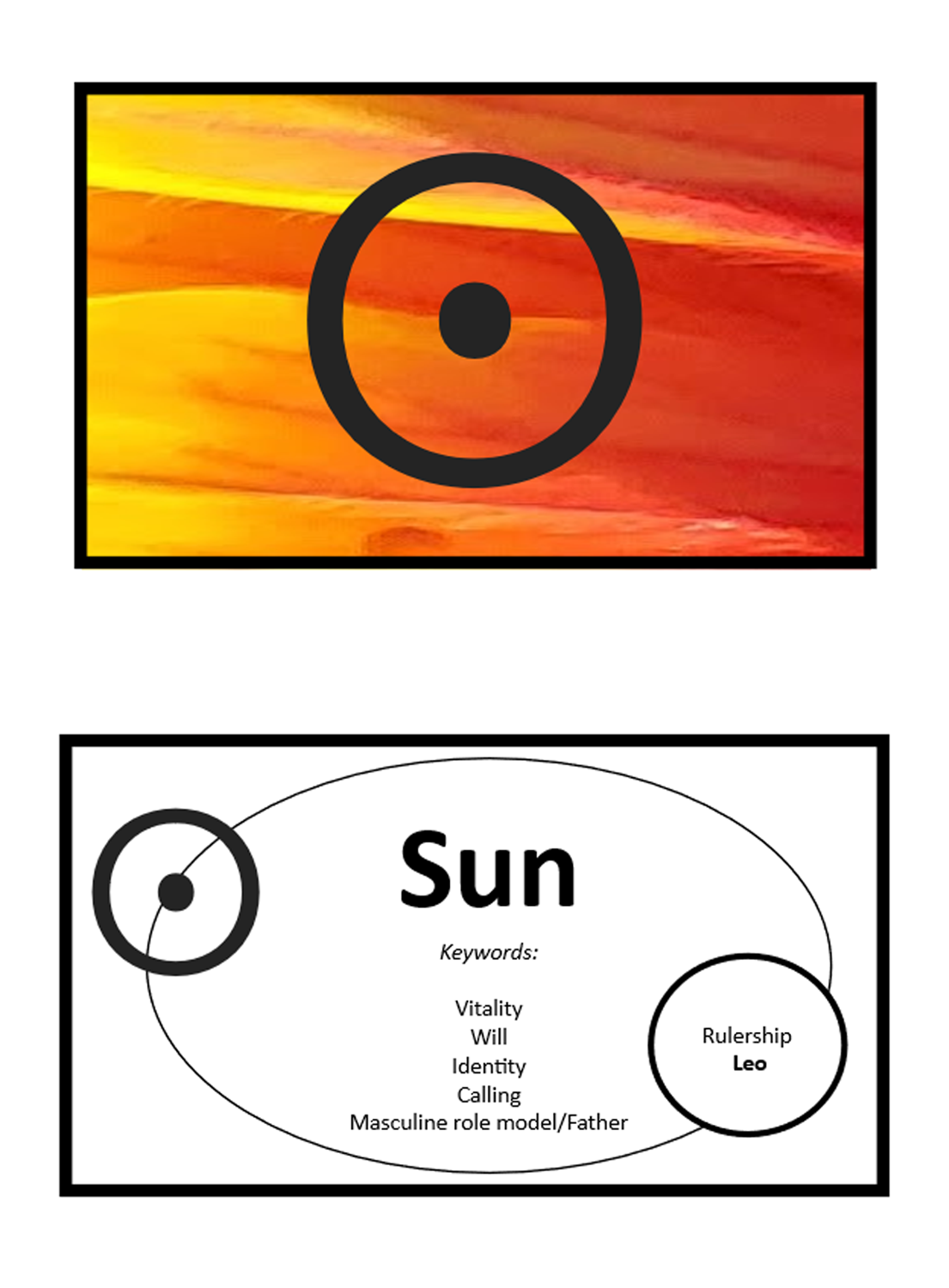
The Sun is the most well-known symbol in the chart. It represents identity, vitality, will and expression, fathering actions, and the conscious self. Where the Moon reflects our inner world, the Sun illuminates our outward expression — how we shine, how we create, and how we embody purpose. The Sun is personal because it symbolizes your core identity, your sense of self, and the way you radiate your energy and light into the world.
The Sun can represent the soul of your essence. It shows how you are seen and how you act in the light of day. It is associated with creativit and leadership. In a natal chart, the Sun often describes the central themes of your life, the qualities you are meant to grow into, and the energy you project outward. Traditionally, the Sun is linked to the father, authority figures, and the principle of order. Just as ancient cultures revered the Sun as the source of life, astrology honors it as the symbol of our conscious will and our essential identity. The Sun shows where we shine, where we must grow, and how we embody our purpose.
The Sun, like the Moon, cannot be captured in a single description. Its themes shift across cultures and traditions, yet its essence remains: vitality, identity, and illumination. To make meaning of your Sun, you must blend its symbolism with the chart’s context — signs, houses, and aspects. This process begins with balance: openness to the Sun’s archetypal meanings, and discernment in how they manifest in your life. The practice is to ask questions, reflect, and notice how your Sun shines in both supportive and challenging ways. We will be focusing on the Sun, to seek insight and to take action when we reflect upon its characteristics and how they are manifesting in our lives. Today instead of blending Sun energies with sign energies, we will be exploring the meaning of the Sun in its house placement. The house of a planet has an impact on a planet’s expression, but in a different way than a sign’s influence.
1. Learn about the function of houses in natal charts. Learn about the house themes. Find your Sun’s house placement and the themes of that house.
2. Blend your Sun’s symbolism with your Sun’s house themes. Just mix and match words, and images.
3. Explore the house’s impact on the Sun. This activity focuses on a quick scenario. Here, the emphasis is on the Sun and house placement: imagine a short scenario, draw a quick insight, and create simple actions you can begin right away. Blend the Sun’s qualities (identity, vitality, illumination) with your house themes.
4. Write one clear insight and one action to honor your Sun when considering your Sun’s expression in its house.
For intermediate and Advanced students add these steps to your instructions before you begin. Beginners — skip ahead.
5. Intermediate —How do Sun house themes work together and connect in multiple scenarios? How do the Sun house themes work together and connect? What more do you understand about your Sun and its layers now?
6. Advanced — How do your Sun’s house themes impact the Sun’s growth over time? How do these energies bless and challenge the Sun’s journey as these themes present possibilities?
Most people know their Sun sign and have done endless reading about the significance of that. So, this article will introduce the meaning of houses and then give an example of blending the Sun's meaning with a house’s meaning. House placement adds a new layer of meaning to a planet's natal interpretation. in its sign (and later in aspects). All of the natal planets are placed in one of the twelve houses in the natal chart. Each house placement has its own impact on the planet’s expression.
Even in the same sign, Suns can show up very differently depending on their house placement. Houses’ symbolism in charts function differently than sign symbolism but both impact signatures. Signs impact expressions through style, focus, and ways of being while houses influence the arenas of life that the expression is often seen as manifesting.
Continually adding layers of meaning and looking at all of the symbolism in a chart clarifies the unique configuration of the chart which allows for insight into its traits, gifts, lessons, and paths.
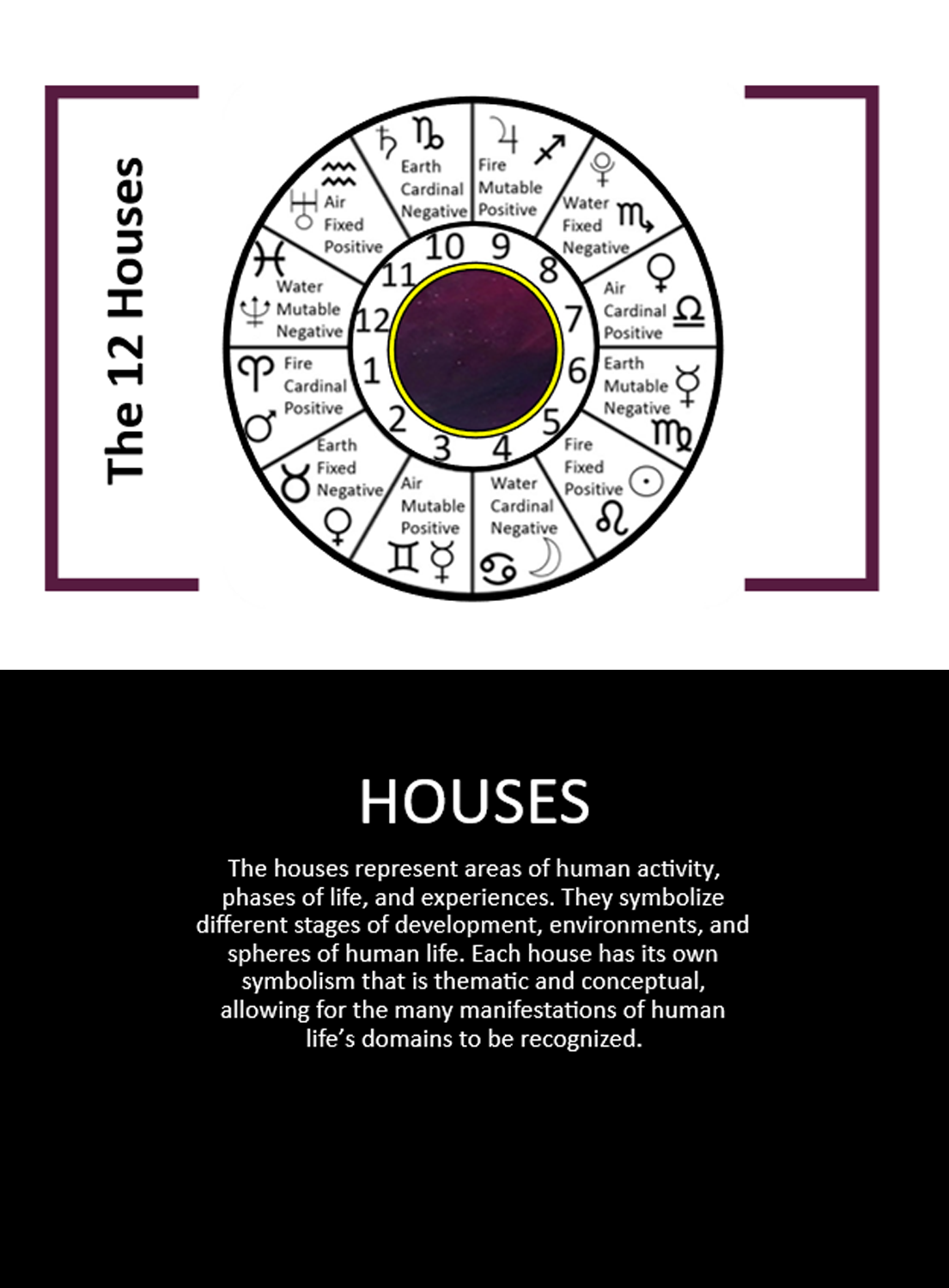
To add this layer of detail and interpretation, first we need to see what the house placement can signify in charts. Below you will see a natal chart with all of the corresponding signs and planets, in the “natural” house. These signs and planets do not show up in actual natal charts in these exact placements and configurations because the image below shows the connections of energies between the houses, signs, and planets that will be explained in more advanced material.
In a real natal chart, the houses do not move, but the signs and planet placements are mixed up making aspects and chart patterns creating unique combinations of meaningful individuality in the chart. First take a moment and use the cards to read about houses’ symbolism and how they function in a natal chart. (If needed you can use the short word list at the end of the article to help you if you do not have house cards.)
Think about how you might interpret your Sun placed in its house. For this exercise, just mix and match the themes, words, and information. Do it with thoughts and ideas that come and go. You do not need to describe characteristics or contemplate deep truths. You can if you want, but for this activity you also need to let the ideas just play. When you are ready, move on to imagine a scenario combining the house and Sun energy.
You can use these guiding questions to help you get started imagining your scenario.
1. Where do you naturally express your vitality and identity?
2. In what environments do you feel most “lit up”? What drains your light, and what restores it?
3. How does the house symbolism describe the arena where your Sun wants to shine?
Third house card used for this example is found below.
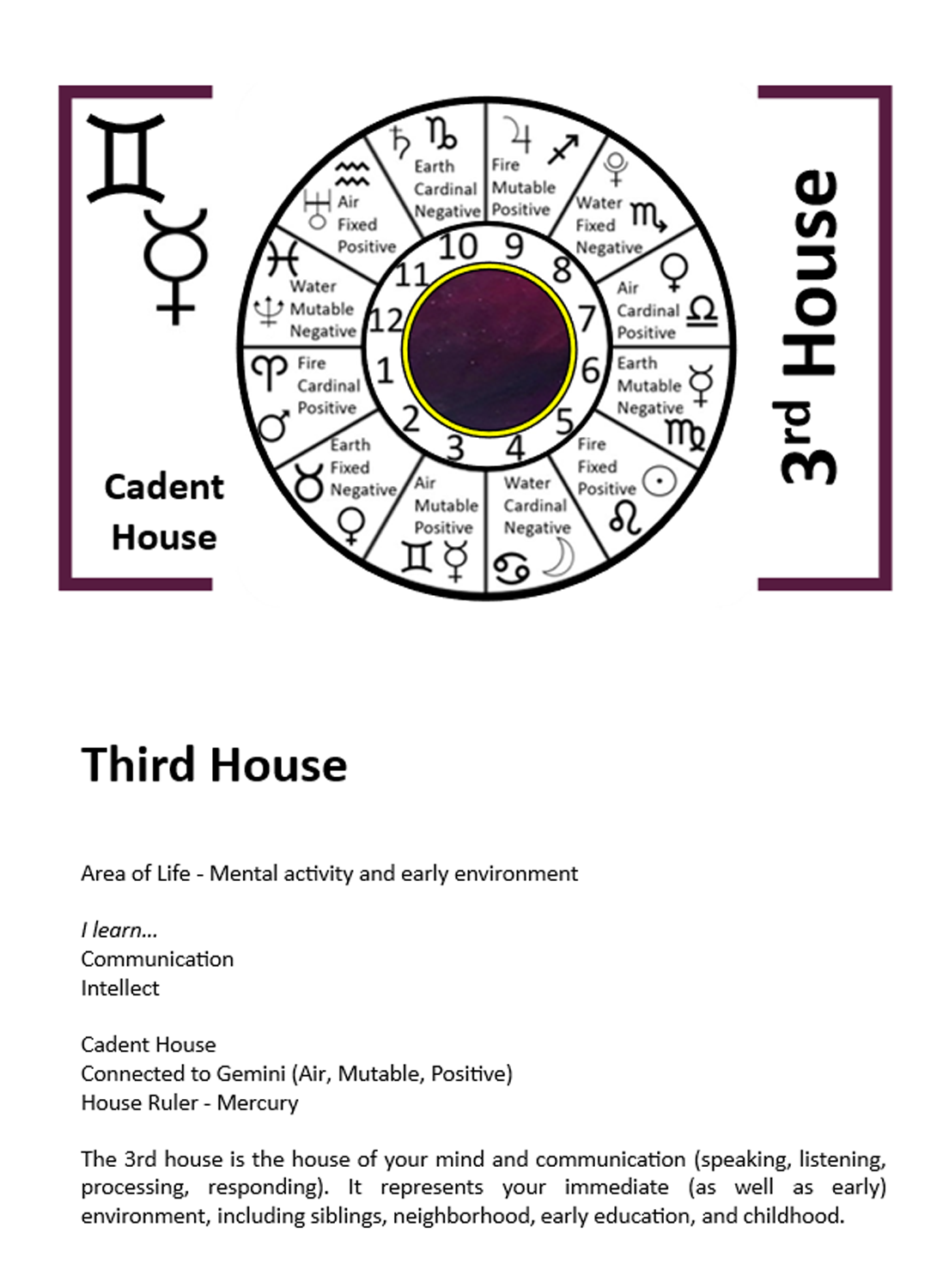
Sun Focus on Third House Themes –
Communication & Learning Scenario:
In the local library a group came together to socialize and spend the afternoon chatting about the new club book, exchanging insights, and leaving feeling inspired. The communication was not in a strictly structured meeting for work, nor was it a private and intense one-to-one conversation focused on hard topics. It was free flowing and fun.
At the Intermediate level, you start layering additional meanings drawn from the Sun’s symbolism and mythology. This means imagining more than one scenario: first, one expression of the Sun in its house placement, and then a second scenario shaped by a different symbolic facet of the Sun. By comparing these scenarios, you see how multiple meanings of the Sun can coexist, overlap, or even challenge one another. This process reveals the Sun’s complexity: identity is not one dimensional, and neither is the Sun’s expression in a chart. Writing different scenarios using different symbolic meanings helps you understand how these layers interact, how they reinforce or modify each other, and how they create a richer, more nuanced picture of the Sun in action. Use the Sun and house work you have already completed in the article activity and answer the questions below for yourself.
How do Sun house themes work together and connect in multiple scenarios? What more do you understand about your Sun and its layers now?
At the Advanced level, you explore how the Sun’s expression evolves across your lifetime. You study your natal Sun house placement, reflect on your lived experience, and identify the repeating themes of its house. When applying personal change and evolution over time to a natal chart placement, both the original Sun placement and how it has developed must be considered. For example, Sun in the 1st house may express itself boldly in youth, but with maturity, that same Sun may become more intentional in its boldness. The Sun in the 8th house may begin life with intense emotional experiences but later grow into deep psychological insight or transformative leadership.
These house themes can bless the Sun with opportunities, while also presenting challenges that reveal blind spots or areas needing development. By examining how the Sun’s house themes influence its growth you begin to see your Sun as an evolving force rather than a fixed trait. This perspective helps you understand how your Sun relates directly to your past, current, and future opportunities for growth. Use the Sun and house work you have already completed in the article activity and answer the questions below for yourself.
How does your Sun house theme impact the Sun’s growth over time? How do these energies bless and challenge the Sun’s journey as these themes present possibilities?
Astrology can be used for deep introspection, and it can also be used for quick observations. It can be used for fun and entertainment and it can be used to guide meaningful introspection leading to growth and transformation. It can be used in any way that fits the moment.
This astro-activity was lighthearted and quick. You practiced your astrological skills by blending the Sun’s qualities — identity, vitality, calling — with the themes of your house to find a quick insight and way to honor how and where you shine. When astrology is studied and then applied it becomes more than abstract symbolism in a chart; it becomes a living practice of self-awareness, self-care, and growth.
Continue exploring your natal chart and upcoming articles that highlight planetary meanings and methods to help you learn about yourself and the universe.
Astrology grows through both self-study and shared wisdom. Articles, cards, and booklets guide study and reflection, and community, mentorship, and classes deepen practice. Your path can be personal and collective, shaped by your own insights and the insights of others. The Insight and Action Astrology Natal Astrology Learning Cards and Foundation Booklet provide a step-by-step framework and much of the information shared in this article series comes from the design of that resource. Some activities and information in the article series will overlap with the cards and booklet work, and some will be unique to the article. Use the articles and Insight and Action Astrology Natal Astrology Learning Cards and Foundation Booklet together for extra enrichment, activities, examples, and support.
(This is a partial description of the houses that comes from a part of the Insight and Action Astrology Learning Cards.)
1st Area of Life - The seen and unhidden self
2nd Area of Life - Personal resources, possessions, and values
3rd Area of Life - Mental activity and early environment
4th Area of Life - Inner, private, and domestic world
5th Area of Life - Leisure and creativity
6th Area of Life - Daily life, tasks, and health
7th Area of Life - Relating to others
8th Area of Life - Transformations, intimacy, and shared resources
9th Area of Life - Explored and expanded horizons
10th Area of Life - Outer world and public recognition
11th Area of Life - Social groups, progressive ideas, and aspirations
12th Area of Life - Spiritual life, isolation, and everything (past, present, future)